
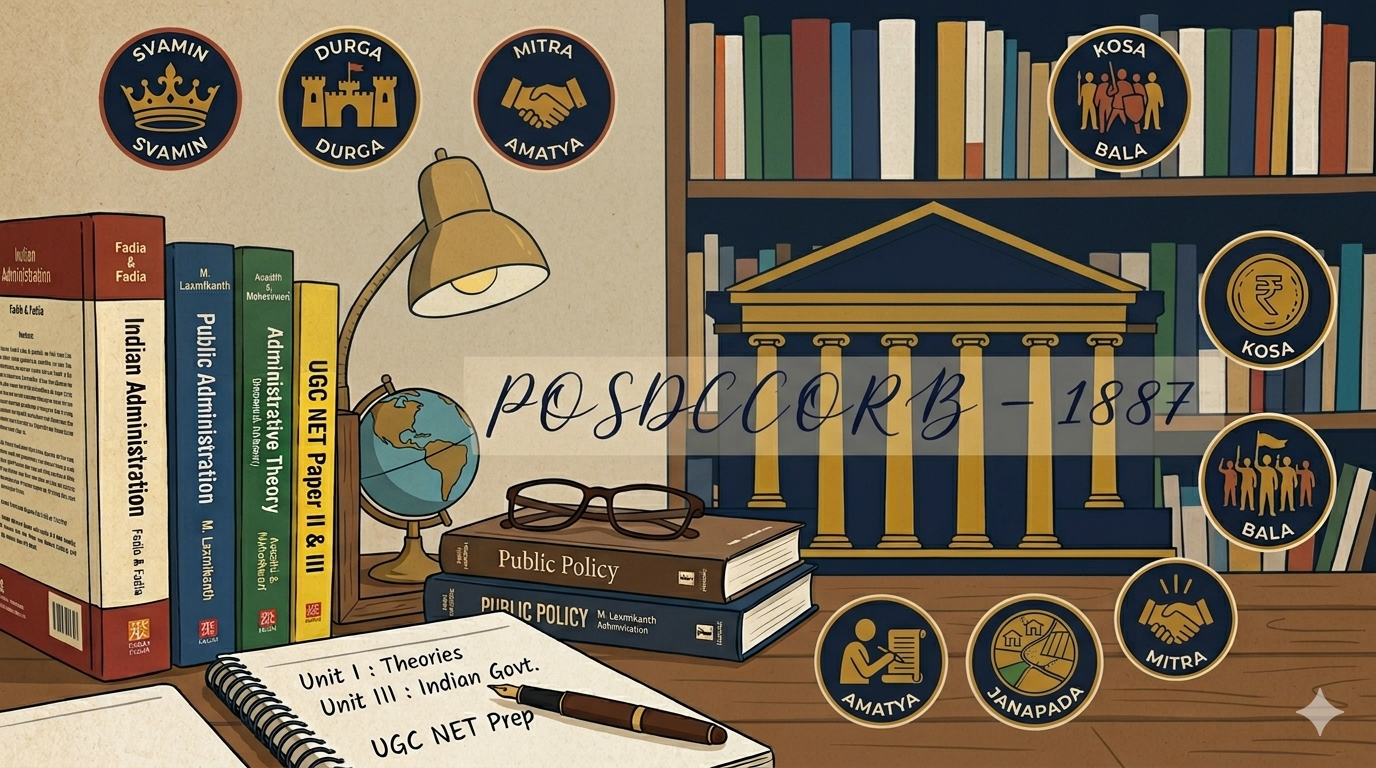

Meaning, Scope and Significance
of Public Administration
A comprehensive study of how Public Administration defines itself, where its boundaries lie, and why it matters — from Wilson’s 1887 essay to the modern governance discourse.
Why This Topic Is the Gateway to Public Administration
Every discipline begins with a fundamental question: what are we studying, and why does it matter? For Public Administration, that question was formally posed in 1887, when Woodrow Wilson published his landmark essay “The Study of Administration.” In that short piece, he argued that government needed not just good laws, but skilled, principled administration to carry those laws into effect.
More than a century later, the question of meaning, scope, and significance remains alive — not because we lack answers, but because administration itself keeps evolving. New forms of governance, technology, and social demands continuously reshape what public administrators do and how they do it. Understanding the foundations of the discipline is therefore not an academic formality; it is the lens through which every other topic in this syllabus must be read.
For UGC NET aspirants, this topic is consistently high-yield. It appears in questions about definitions, dichotomy, POSDCORB, and the evolving nature of the field. Mastering it thoroughly builds conceptual vocabulary you will use across all ten units.
What Is Public Administration? Definitions by Key Scholars
Public Administration resists a single, universally accepted definition. Each scholar has approached it through the lens of their own intellectual tradition — some emphasising the legal-constitutional framework, others the managerial process, and still others the social purpose of administration. The definitions below, drawn from the discipline’s major thinkers, represent these distinct perspectives.
“Detailed and systematic execution of public law… government in action; the executive, the operative, the most visible side of government.”
“The management of men and materials in the service of the state.”
“Domination or exercise of authority” — administration as the legitimate exercise of organised power within a defined legal-rational order.
All undertakings require “planning, organisation, command, coordination and control” — applicable equally to private and public enterprises.
“The use of managerial, legal and political theories and processes to fulfil legislative, executive and judicial governmental mandates.”
Administrative efficiency is “a function of social efficiency” — it is the effective application of social justice principles in governance.
Kautilya’s Arthashastra: The Ancient Dimension
Indian intellectual tradition had its own administrative theory long before Wilson. Kautilya’s Arthashastra discusses what he termed Rakshana-Palana — the protection and welfare functions of the ruler. Central to this framework is the Saptanga Theory: seven elements of the state, namely Swami (ruler), Amatya (ministers), Janpada (territory and population), Durga (fort), Kosha (treasury), Danda (army/justice), and Mitra (ally). This model established that governance involves far more than law enforcement — it is a comprehensive system of statecraft.
Scope of Public Administration: How Wide Is the Field?
The scope of any discipline defines where its concerns begin and end. For Public Administration, this has been fiercely debated since the field’s inception. Two broad positions dominate the literature: the narrow (managerial) view and the broad (integral) view.
| Dimension | Narrow / Managerial View | Broad / Integral View |
|---|---|---|
| Coverage | Executive branch only | All three branches of government |
| Key Thinker | Luther Gulick (POSDCORB) | Marshall Dimock, Dwight Waldo |
| Focus | Technical efficiency of management | Full governmental process including policy |
| Nature | Science of administration | Art and science of governance |
| Criticism | Too narrow; ignores legislative/judicial | Too vague; lacks clear boundaries |
POSDCORB — The Narrow View in Practice
Luther Gulick crystallised the narrow view in one of the discipline’s most memorable acronyms. In his 1937 paper “Notes on the Theory of Organization” (published in Papers on the Science of Administration, edited with Lyndall Urwick), Gulick identified the seven functions of the chief executive:
Herbert Simon later criticised these principles as mere “proverbs” — appealing but offering contradictory guidance in practice. For instance, the principle of specialisation often conflicts with the principle of unity of command. Despite this criticism, POSDCORB remains a foundational framework and a staple of UGC NET questions.
Piffiner’s Classification of Scope
John M. Piffiner offered a useful two-part framework for understanding the scope of Public Administration:
- Principles of Public Administration — Theoretical rules governing administrative organisation, such as hierarchy, span of control, and unity of command.
- Sphere of Public Administration — The substantive areas in which government operates: defence, health, education, agriculture, welfare, and so on.
The Unsettled Boundary: Dwight Waldo’s Observation
Dwight Waldo, one of the discipline’s most reflective critics, argued that Public Administration has never had a “settled boundary.” The scope of government activity — and therefore of administration — constantly expands and contracts in response to economic crises, social demands, technological change, and political ideology. This observation is important: it means the field must always be understood in context, not defined once and for all.
Nicholas Henry’s Five Evolutionary Phases
Nicholas Henry traced how scholars’ understanding of the scope and identity of Public Administration has shifted over time:
Why Does Public Administration Matter?
The significance of Public Administration goes beyond academic categorisation. It is the machinery through which the state delivers on its promises — to educate, protect, develop, and serve its citizens. Several dimensions of this significance deserve careful attention.
| Dimension | What It Means | Key Thinker / Context |
|---|---|---|
| Analytical Foundation | Established government conduct as a subject of systematic study and generalisation | Woodrow Wilson (1887) |
| Instrument of Welfare | Acts as trustee for improving health, food security, agriculture, and education | Post-welfare state paradigm |
| Foundation of Civilisation | Administration gives civilisation its structure and enables social progress | Dwight Waldo |
| Crisis Response | In crises (drought, flood, pandemic), administration’s primacy over cost-efficiency becomes visible | Emergency governance theory |
| Moral Leadership | Administrators model professional and ethical behaviour in public life | Administrative ethics literature |
| Social Justice | Administrative efficiency is inseparable from social efficiency | Dr. B. R. Ambedkar |
Ambedkar’s formulation deserves particular emphasis in the Indian context. He argued that administrative efficiency cannot be measured purely in procedural or financial terms; it must be evaluated by whether it achieves social justice outcomes for the marginalised. This perspective anticipates later debates about equity in New Public Administration (NPA) and Good Governance frameworks.
Public Administration vs Private Administration
One of the earliest debates in the discipline asks whether public administration is fundamentally different from the management of private organisations, or whether they share a common administrative science. Two schools of thought have emerged.
| Basis | Public Administration | Private Administration |
|---|---|---|
| Primary Objective | General welfare and public interest | Profit maximisation |
| Accountability | To the legislature, judiciary, and citizens | To shareholders and board |
| Legal Constraint | Strictly bound by law, rules, and precedent | Considerable flexibility within law |
| Public Scrutiny | Heavily exposed to media and public gaze | Relatively sheltered from scrutiny |
| Coercive Power | Possesses sovereign power of the state | No coercive authority; must approach courts |
| Political Context | Operates within a political environment of pressures and pulls | Single-minded business focus |
| Flexibility | Limited; bound by procedure | Greater adaptability |
The Generic Management View
Several major thinkers have argued that the two are more alike than different. Henri Fayol asserted there is only “one” administrative science applicable equally to both sectors. Herbert Simon believed administration is a common science with more similarities than differences between sectors. Peter Drucker famously estimated that 90% of management is generic across sectors, with only 10% needing adaptation to a specific mission or culture.
The Distinction View
Wallace Sayre offered perhaps the sharpest rebuttal: “Business and public organisations are alike in only all unimportant respects.” This aphorism captures a fundamental insight — that the differences, though fewer in number, are decisive in nature. A private firm can change its product; a government cannot change its obligations to citizens. That asymmetry shapes everything about how public administration must work.
Important Scholars and Their Contributions
| Scholar | Period | Key Contribution |
|---|---|---|
| Woodrow Wilson | 1887 | Father of Public Administration; proposed politics-administration dichotomy; argued for administration as a separate field of scientific study. |
| Frank J. Goodnow | 1900 | Clarified the dichotomy: Politics = “will of the state”; Administration = “execution of policies.” |
| L. D. White | 1926 | Authored the first textbook in Public Administration; defined it as “management of men and materials in the service of the state.” |
| Luther Gulick | 1937 | Developed POSDCORB; champion of the Era of Principles alongside Lyndall Urwick. |
| Max Weber | Early 20th C. | Developed the Ideal Type of legal-rational bureaucracy; defined administration as “domination or exercise of authority.” |
| Herbert Simon | 1947 | Attacked classical principles as “proverbs”; focused on decision-making and bounded rationality in Administrative Behaviour. |
| Dwight Waldo | 1948+ | Wrote The Administrative State; challenged scientific pretensions of classical PA; key figure in New Public Administration. |
| Robert A. Dahl | 1947 | Challenged the possibility of a “science” of PA, noting the impossibility of excluding normative values and human behaviour variables. |
| Fred W. Riggs | 1960s | Developed the Prismatic-Sala model and ecological approach to Comparative Public Administration. |
| Peter Drucker | 20th C. | Conceptualised Management by Objectives (MBO) and the “knowledge worker”; argued 90% of management is generic. |
| Kautilya | 4th C. BCE | Arthashastra; Saptanga Theory; Rakshana-Palana functions; precursor to administrative statecraft in India. |
| Yehezkel Dror | 1960s+ | Pioneer in “Policy Sciences”; bridged the gap between knowledge and policy practice. |
Important Years, Committees, and Reports
Important Committees (India)
| Committee / Report | Key Significance |
|---|---|
| Santhanam Committee | Focused on prevention of corruption in public services. |
| 1st ARC (Administrative Reforms Commission) | Initially headed by Morarji Desai, then K. Hanumanthaiah; comprehensive administrative reform recommendations. |
| Appleby Report | Instrumental in establishing the Indian Institute of Public Administration (IIPA). |
Previous Year Question Patterns
Questions from Topic 1.1 appear regularly across UGC NET examinations. Based on the pattern of past papers, the following question types recur most frequently:
Deeper Analysis: The Politics-Administration Dichotomy
No concept in the history of Public Administration has generated more debate, revision, and eventual rejection — yet continues to shape how we talk about the discipline — than the politics-administration dichotomy. Understanding it deeply, including its strengths, its critics, and its legacy, is essential for both exam success and intellectual clarity.
The Original Argument (Wilson, 1887)
Wilson wrote at a time when American public life was saturated with patronage politics — jobs given as political rewards, not based on merit. His argument was essentially reformist: take administration out of politics, staff it with trained professionals, and it will become more efficient and less corrupt. The dichotomy was a tool for reform as much as a theoretical claim.
Goodnow’s Refinement (1900)
Frank Goodnow gave the dichotomy its cleanest formulation: politics represents the “expression of the will of the state” while administration represents the “execution of that will.” This seemed logical — someone decides, someone implements. But it assumed a clean separation that real governance does not permit.
The Breakdown of the Dichotomy
By the mid-20th century, scholars recognised that the separation was untenable in practice. Administrators exercise discretion constantly: they interpret ambiguous laws, prioritise among competing demands, and shape policy through implementation choices. As Paul Appleby observed, administration is not merely execution — it is inherently political. The recognition of this reality was what drove Phase 3 of Nicholas Henry’s evolution: Public Administration as Political Science.
Christopher Hood’s Four Administrative Tools
A more contemporary analytical framework comes from Christopher Hood, who identified four core categories of tools that governments use to administer: Authority (legal mandates and regulations), Economic Incentives (subsidies, taxes, payments), Information and Persuasion (communication, campaigns), and Organisation (institutional structures). This typology is useful for understanding modern governance and e-governance questions in Units I and IX.
High-Value Exam-Oriented Facts
| Fact | Detail |
|---|---|
| L. F. Urwick — Span of Control | No supervisor can directly supervise more than five or at most six subordinates. |
| Dry Promotion | A promotion that does not include an increase in salary. |
| March Rush | Caused by the “Rule of Lapse” — unspent budget funds lapse at year-end, prompting rushed expenditure in March. |
| NPA’s Quest | New Public Administration seeks relevance, values, social equity, and change. |
| Tragedy of the Commons | What is owned by nobody cannot be protected (Hardin’s concept, applicable to public goods). |
| LBSNAA Foundation Course | Duration is 15 weeks (approximately 4 months). |
| Rule of Law | Concept whose origin is attributed to A. V. Dicey. |
| Alberto Ramos | Described the contemporary state of the PA field as a “hodgepodge of theoretical ramblings.” |
| Kautilya’s Janpada | Represents both territory and population in the Saptanga Theory. |
| Ambedkar on Efficiency | Administrative efficiency = function of social efficiency (social justice). |
Practice Questions with Explanations
Quick Revision Points
Frequently Asked Questions
What This Topic Establishes
Public Administration begins with a deceptively simple question — what is it, and what is it for? The answers scholars have given over more than a century reveal a discipline in constant dialogue with itself. Wilson wanted to clean up corrupt government. Weber wanted to explain why rational bureaucracy had become dominant. Simon wanted to ground administration in realistic psychology. Ambedkar wanted it to deliver justice.
None of these answers is complete on its own. Together, they map the terrain of what Public Administration is: a field that sits at the intersection of management, law, politics, and social values — and must honour all of them simultaneously.
For UGC NET preparation, the practical implication is this: know your definitions with their correct attributions, understand the evolution of the field through Nicholas Henry’s phases, master POSDCORB and its critics, and keep the Public-Private distinction sharp. These are not isolated facts — they are the conceptual vocabulary of the entire subject.