
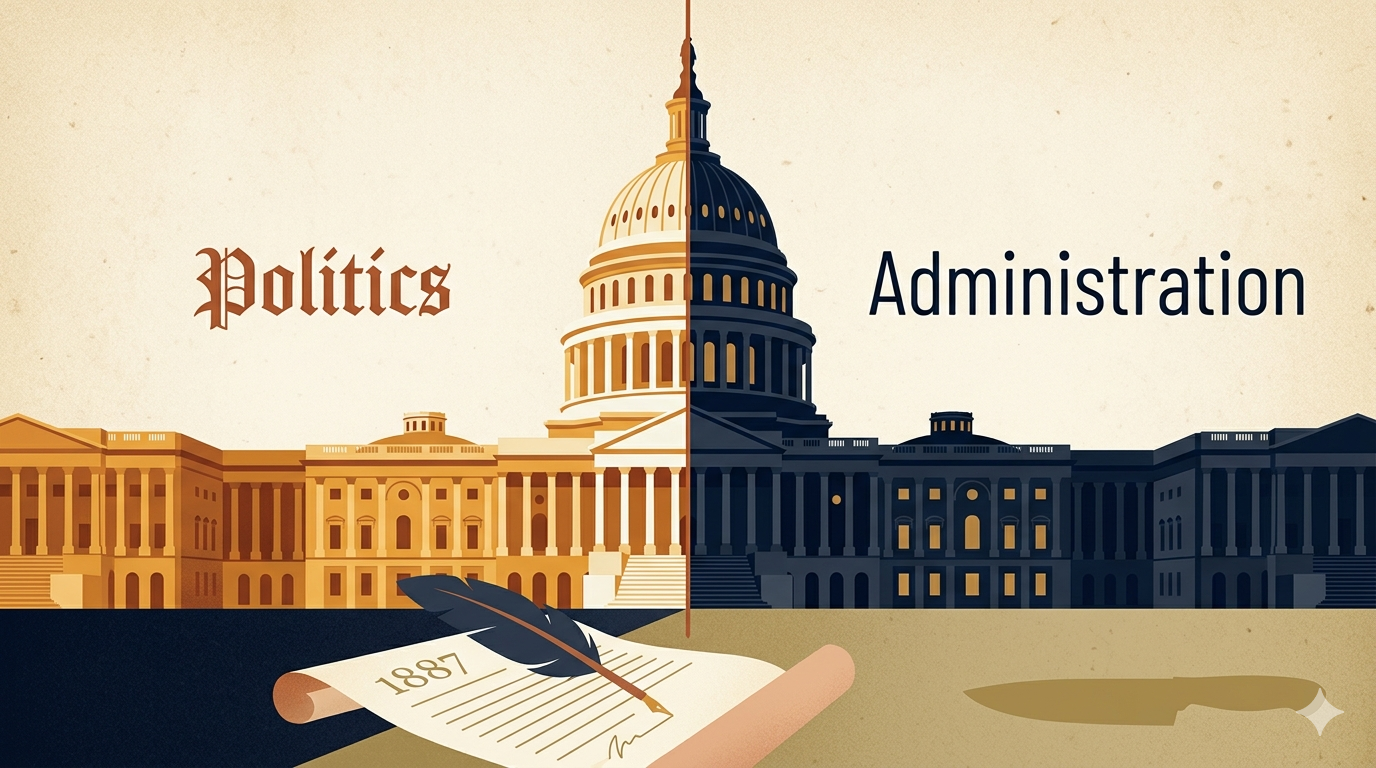

Wilson’s Vision of
Public Administration
A deep study of Woodrow Wilson’s founding argument — why he called for a science of administration, how he drew the line between politics and administration, and why his 1887 essay remains the discipline’s most important document.
Why Wilson’s Essay Is the Founding Document of a Discipline
In 1887, a 31-year-old political science professor named Woodrow Wilson published a short essay in Political Science Quarterly. It was titled simply “The Study of Administration.” Wilson himself later admitted it was “too general, too broad and too vague” — and yet that essay is recognised today as the symbolic starting point of Public Administration as a formal field of study.
Wilson was writing at a specific moment of crisis. American public life in the 1880s was saturated with the “spoils system” — a patronage-driven model where government jobs were handed out as political rewards rather than on merit. Corruption was visible, waste was rampant, and the state was growing more complex by the year. Wilson’s response was not to propose better laws. It was to argue that the problem was not in the law itself, but in how the law was being carried out — and that improving administration required treating it as a serious, scientific discipline.
For UGC NET aspirants, this topic is consistently high-yield. Wilson’s definitions, the Wilsonian Dichotomy, his business-administration analogy, and his views on comparative administration all appear regularly in both direct and assertion-reason type questions.
📋 In This Article
The World Wilson Was Responding To
Understanding Wilson’s vision requires understanding the context in which it was formed. The late 19th century was a period of rapid transformation in American society — and the administrative machinery of government was struggling to keep pace.
| Factor | What Was Happening | Wilson’s Response |
|---|---|---|
| Spoils System | Government jobs distributed as political patronage; rampant corruption and inefficiency | Argued for merit-based, professionally trained administration separate from political influence |
| Growing Complexity | Expanding trade, giant corporations, population growth; simple administrative methods becoming obsolete | Called for a science of administration with stable, transferable principles |
| Constitutional Focus | Political thinkers preoccupied with “who should make laws” — administrative “details” left to clerks | Argued the challenge had shifted from framing constitutions to efficiently running them |
| European Models | Prussia and France had developed advanced, systematic administrative techniques | Proposed borrowing their methods while filtering out their autocratic values |
It is getting harder to run a constitution than to frame one.
— Woodrow Wilson, 1887This single sentence captures Wilson’s entire intellectual project. Constitutional design had occupied political thinkers for centuries. But Wilson saw that the real challenge of his era was not designing the machinery of government — it was operating it effectively, honestly, and at scale.
What Wilson Was Arguing For
Wilson’s central thesis had three interlocking parts that built on each other logically.
PA should be established as a distinct, scientific discipline — a “professional specialty” — not merely a byproduct of political science or law.
Executive methods should be “rescued from empirical experiment” and placed on stable, transferable principles derived from systematic study.
His primary objective was to “straighten the paths of government,” make its business “less un-businesslike,” and “crown its duties with dutifulness.”
“The detailed and systematic execution of public law” — every application of a general law is an administrative act. Government in action; the executive, the operative, the most visible side of government.
The Politics-Administration Dichotomy
The most influential — and most debated — element of Wilson’s vision is what became known as the Wilsonian Dichotomy: the idea that politics and administration operate in fundamentally different spheres and should be kept separate.
| Dimension | Politics | Administration |
|---|---|---|
| Domain | Policy formulation; the will of the state | Policy execution; implementation of law |
| Province of | The Statesman | The Technical Official |
| Nature | Value-laden, contested, political | Technical, neutral, professional |
| Concern | “Who” should govern and “what” should be done | “How” things should be done efficiently |
| Sphere | The proper realm of democratic debate | Outside the “hurry and strife of politics” |
Wilson’s Own Words on the Dichotomy
Administration lies outside the proper sphere of politics. Administrative questions are not political questions.
— Woodrow Wilson, 1887The Inherent Ambivalence Wilson Himself Recognised
Significantly — and this is frequently tested — Wilson did not argue for a total separation. He acknowledged that administration must “mirror the principles of government in operation” and that its foundations are “the permanent principles of politics.” This created an internal contradiction in his framework: he simultaneously argued that politics and administration are separate and that they are fundamentally intertwined.
Later scholars, particularly Dwight Waldo, seized on this inconsistency. Waldo pointed out that it is logically untenable to claim administrators merely execute law without exercising political judgment — because every act of implementation involves discretion, prioritisation, and interpretation. The recognition of this reality eventually drove the evolution from Phase 1 to Phase 3 in Nicholas Henry’s classification.
Wilson’s Case for a Science of Administration
Wilson characterised the “science of administration” as the “latest fruit of the study of the science of politics.” This was a deliberately ambitious claim — he was arguing that just as natural science had found stable laws in nature, political science should be able to identify stable principles of administration.
His reasoning had a practical edge. Without a science of administration — without stable, teachable principles — every new government would have to reinvent its methods through costly trial and error. A science of administration would make expertise transferable, training systematic, and improvement cumulative.
Wilson also argued that this science would provide the basis for a merit-based civil service: technically schooled officials who earned their positions through demonstrated competence rather than political connection. This vision directly laid the groundwork for the civil service reform movement of the late 19th and early 20th centuries.
Administration as a Field of Business
One of Wilson’s most provocative claims was that “the field of administration is a field of business” — removed from the “hurry and strife of politics.” This was not a statement about privatisation. It was an argument about professional values: that administration should adopt the same commitment to economy, efficiency, and effectiveness that characterises well-run private enterprise.
His goal was to make government “less un-businesslike” — a deliberately awkward double negative that captured his frustration with how casually government managed its affairs compared to how seriously a well-run business managed its own.
| Principle | What Wilson Meant |
|---|---|
| Economy | Avoiding waste; doing more with less; responsible use of public resources |
| Efficiency | Achieving maximum output from given inputs; speed and accuracy in execution |
| Effectiveness | Actually accomplishing the intended purpose of public law; “crowning duties with dutifulness” |
| Professionalism | Building a corps of trained, merit-based officials who treat administration as a career, not a reward |
Learning from Europe: The Knife-Sharpening Analogy
Wilson faced an obvious political objection to his proposal: how could an American democracy borrow administrative methods from authoritarian states like Prussia and France without importing their autocratic values?
His answer was both practical and elegant. He drew a distinction between a technique and the intention behind it. Advanced administrative methods are morally neutral tools — what matters is the political system in which they are used.
If I see a murderous fellow sharpening the knife cleverly, I can borrow his ways of sharpening the knife without borrowing his probable intention to commit murder with it.
— Woodrow Wilson, 1887Wilson also recognised that administrative technology cannot be transplanted wholesale. It must be “filtered through the cultural lens” of the borrowing nation — adapted to its values, its constitutional framework, and its political traditions. A technique that works in a centralised bureaucratic state may need significant modification before it works in a federal democracy.
This argument makes Wilson not just a founding figure in Public Administration, but also an early voice in Comparative Public Administration — the systematic study of administrative systems across different political and cultural contexts.
Wilson’s Most Exam-Relevant Quotes
| Quote | Significance |
|---|---|
| “It is getting harder to run a constitution than to frame one.” | Captures the shift from constitutional design to administrative efficiency as the central political challenge. |
| “The field of administration is a field of business.” | Argues for professional, efficiency-oriented administration modelled on business values — not privatisation. |
| “Government in action; the executive, the operative, the most visible side of the government.” | Wilson’s description of what Public Administration actually is in practice. |
| “Public administration is the detailed and systematic execution of public law.” | Wilson’s formal definition — the most tested line in this topic. |
| “Administration lies outside the proper sphere of politics.” | The core claim of the Wilsonian Dichotomy — politics and administration as separate domains. |
Criticisms and Limitations of Wilson’s Vision
Wilson’s essay was transformative, but it was far from beyond criticism. Several major scholars have identified fundamental weaknesses in his framework.
| Critic | Criticism |
|---|---|
| Wilson Himself | Admitted his 1887 essay was “too general, too broad and too vague” — acknowledging the imprecision of his own foundational argument. |
| Dwight Waldo | Pointed out the serious internal inconsistency: Wilson argued for separation of politics and administration while simultaneously acknowledging their intertwined nature. You cannot have both. |
| Paul Van Riper | Questioned the assumption that Wilson was the sole or primary founder of PA, attributing administrative roots to the American Founding Fathers and earlier political thinkers. |
| Later Behavioural Scholars | Challenged his “scientific pretensions” — arguing that his so-called principles were largely extensions of common sense rather than scientifically validated propositions. |
| Post-War PA Scholars | Demonstrated through empirical observation that administrators inevitably exercise political discretion — making the dichotomy descriptively false, not just theoretically flawed. |
Scholars Associated with Wilson’s Vision
| Scholar | Relationship to Wilson’s Vision |
|---|---|
| Woodrow Wilson | Father of Public Administration; 1887 essay established PA as a distinct field; proposed the politics-administration dichotomy and the science of administration. |
| Frank J. Goodnow | Refined Wilson’s dichotomy in 1900: Politics = “expression of the will of the state”; Administration = “execution of that will.” Gave the framework its clearest formulation. |
| Dwight Waldo | Principal critic; wrote The Administrative State (1948); exposed the internal contradiction in Wilson’s separation of politics and administration. |
| Paul Van Riper | Questioned Wilson’s status as sole founder; argued administrative traditions predated Wilson’s 1887 essay. |
| Paul Appleby | Empirically demonstrated that administration is inherently political — administrators shape policy through every implementation decision. |
| Herbert Simon | While his main target was the classical principles (not the dichotomy directly), his emphasis on decision-making and bounded rationality fundamentally challenged the idea of a value-neutral administrative science. |
Previous Year Question Patterns
Questions on Wilson’s vision appear across multiple formats in UGC NET examinations. The following patterns recur most frequently:
High-Value Exam-Oriented Facts
| Fact | Detail |
|---|---|
| Year of Essay | 1887 — published in Political Science Quarterly. |
| Wilson’s Title | “Father of Public Administration” — universally acknowledged. |
| Essay’s Status | “Symbolic harbinger” and most important document in the development of PA. |
| His Own Admission | Wilson called his essay “too general, too broad and too vague.” |
| Wilsonian Dichotomy | Separation of politics (statesman) from administration (technical official). |
| Business Analogy | “Field of administration is a field of business” = professionalism, NOT privatisation. |
| Knife Analogy | Used to justify borrowing administrative techniques from Prussia/France without importing autocracy. |
| Cultural Filter | Administrative technology must be filtered through the cultural lens of the borrowing nation. |
| Wilson’s Goal | “Straighten the paths of government”; make it “less un-businesslike”; “crown duties with dutifulness.” |
| Critic — Waldo | Exposed internal inconsistency: Wilson’s own text contradicts the strict dichotomy. |
| Critic — Van Riper | Questioned Wilson as sole founder of PA. |
| Goodnow’s Refinement | Politics = will of state; Administration = execution of that will (1900). |
Practice Questions with Explanations
Quick Revision Points
Frequently Asked Questions
📊 Topic-wise Exam Importance
What Wilson’s Vision Established — and Left Unresolved
Wilson’s 1887 essay did something remarkable: it named a problem, proposed a solution, and gave a nascent academic community a vocabulary to work with. The problem was corrupt, inefficient government. The solution was a professional science of administration, separated from politics, modelled on business efficiency, and capable of learning from any source — even an authoritarian one — if the lessons were properly filtered.
What Wilson could not resolve — what no one could resolve, because it is genuinely irresolvable — is the tension at the heart of his dichotomy. Administration and politics are not, in practice, separable. Every administrative act involves judgment. Every judgment involves values. Every application of values is political. Wilson glimpsed this himself, which is why he simultaneously argued for separation and acknowledged interdependence.
For UGC NET preparation, the lesson is clear: know Wilson’s definitions precisely, understand the dichotomy fully including its internal contradiction, master the knife analogy and what it represents, and know the names of his principal critics. These are not peripheral details — they are the conceptual bedrock on which the rest of Unit I is built.